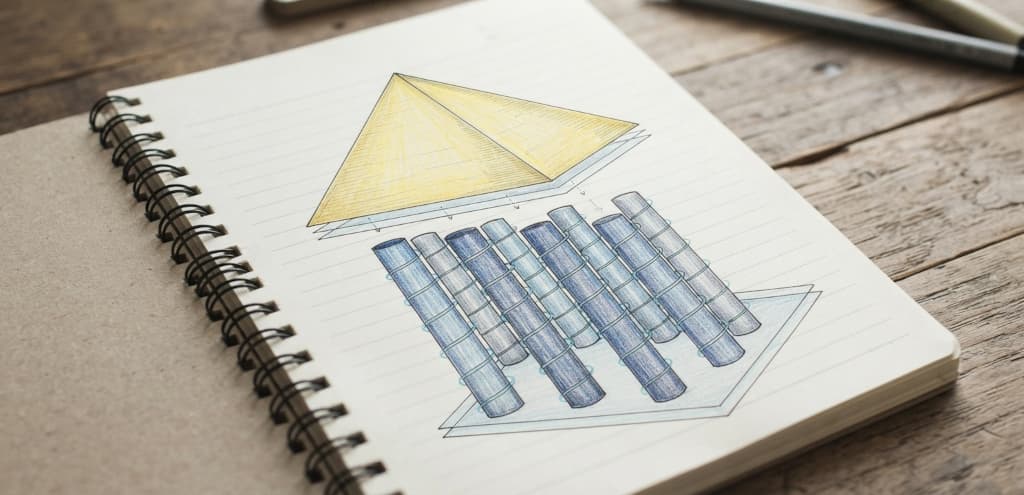
Remote viewing practitioners are especially interested in places with a rich history, symbols, and mysteries.
And Italy is amazing in this regard — from the Pyramid of Cestius, the sunken Baths of Baiae, and the Roman Forum to the mysterious “Sphere Within Sphere,” which some theories link to Agartha.
Actually, more than half of Europe’s cultural heritage is found in Italy, making it an endless field for remote viewing practice.
Biggest Mysteries in Italy
Lake Sirino is a remnant of a much larger Pleistocene-era lake that once filled the valley where the River Noce now flows. It sits in a karst sinkhole formed in limestone and is fed by perennial springs. But according to the legend, the lake formed by a sudden, violent storm that flooded the farmers’ farmyard as punishment for neglecting the holy day dedicated to the Madonna of Sirino and working instead of praying.
Gaiola Island is a pair of tiny islands connected by a thin stone arch just off the coast of Naples. The island is believed to be cursed. Its troubled history began in the early 19th century with a hermit known as “The Wizard.” During the 20th century, the island and the villa built on it were owned by many different people, all of whom suffered various misfortunes.
Salerno Medieval Aqueduct is a massive 9th-century aqueduct built in the historic center of Salerno to bring water to the nearby monastery of St. Benedict.
Locals believed the arches were too advanced for humans to have built. According to legend, the 12th-century magician and alchemist Pietro Barliario made a pact with demons, and together they built the entire aqueduct during a single stormy night. That’s why it became known as Ponte del Diavolo — the Devil’s Bridge.
Another legend says Europe’s first medical school was born here. The four strangers took shelter beneath the aqueduct during a violent storm: a Greek, a Latin, an Arab, and a Jew. Each turned out to be a physician. They shared their medical knowledge and decided to found the Schola Medica Salernitana, considered Europe’s first great medical school.
The Sunken Baths of Baiae — beneath the waters of the Bay of Naples lies part of what was once one of the Roman Empire’s most luxurious resorts. Baiae was famous for its villas, hot springs, parties, and scandals before volcanic activity slowly caused the land to sink. But the real mystery is underground: a network of ancient tunnels was discovered here, and some researchers believe they may have been used for rituals designed to make visitors believe they had entered the underworld.
Roman Forum — the heart of ancient Rome hides one of its strangest legends beneath the ruins. According to Roman tradition, a huge chasm suddenly opened in the Forum and could not be filled. An oracle said Rome could only be saved by sacrificing its most valuable possession. A young soldier named Marcus Curtius realized that Rome’s greatest treasure was its courage, then rode fully armed into the chasm. The earth closed behind him, and the place became known as the Lacus Curtius.
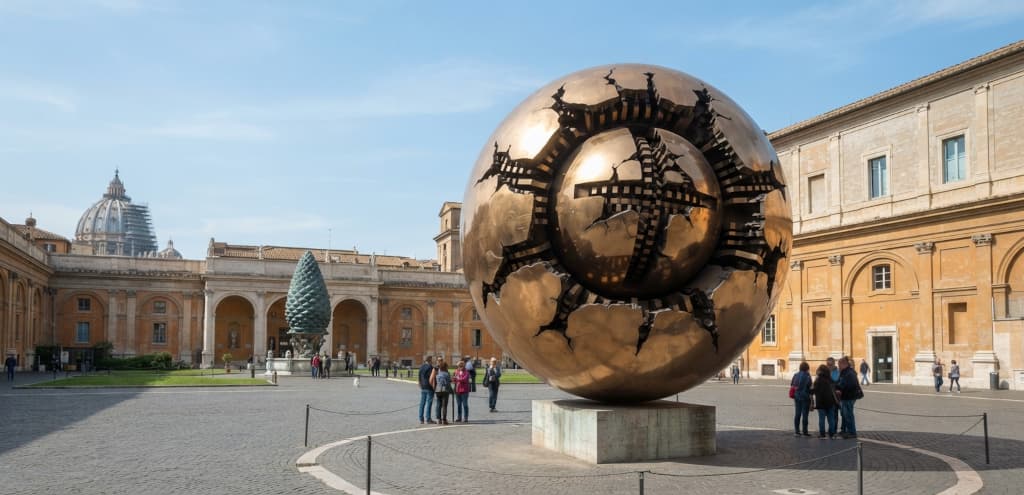
“Sphere Within Sphere” is a giant bronze sculpture by Arnaldo Pomodoro hidden in the Vatican Museums. At first it looks like a perfect golden sphere, but cracks in its surface reveal a second sphere and a complicated mass of gears inside. The sculpture was installed in 1990 and can actually rotate. The sculpture is linked to theories about Agartha, a secret kingdom said to exist deep under the Earth and believed to be home to the mystical city of Shambala, with hidden entrances around the world. Reports ranging from Nazi Germany to Admiral Byrd have claimed that this kingdom exists.
Pyramid of Cestius — a strange Egyptian-style pyramid standing in the middle of Rome. Built as the tomb of Gaius Cestius between 18 and 12 BC, it was later incorporated into the Aurelian Walls. But during the Middle Ages, people forgot who was buried there and believed the pyramid was actually the tomb of Remus, the legendary founder of Rome’s twin brother. The truth was only confirmed centuries later when the inscriptions on the pyramid were uncovered.
Church of San Giacomo di Rialto is the oldest church in Venice, supposedly consecrated in 421, the legendary year Venice was founded. But its true age remains uncertain. Modern evidence points to a much later date, with the first known document mentioning the church dating to 1152. The church is unusual for its Gothic portico, bell-gable, and a strange 24-hour clock with only one hand and a reversed dial.
In Conclusion
Italy is truly full of mysterious places, and some of them still have no clear explanation. Remote viewers, who practice psi-based information gathering under essential blind scientific protocols, may offer another perspective on such mysteries. In fact, remote viewing has already been used to identify hidden mega-structures beneath the Pyramid of Khafre and the Giza Plateau, with further recognition by satellite operators.
 English
 Italian